PhDHealth Risk and Prevention · ETH Zurich and Singapore–ETH Centre, 2025
Affiliations
ETH Zurich
Singapore–ETH Centre
Bond University
Bournemouth University
TU Berlin
University of Padova
About
I am a digital health scientist and UX researcher working at the intersection of cognitive neuroscience, human–computer interaction, and scalable healthcare innovation. My work focuses on developing and validating digital tools that enable earlier detection of cognitive decline and more personalised risk assessment across clinical and population settings.
I completed my PhD in Health Risk and Prevention at ETH Zurich and the Singapore–ETH Centre within the Future Health Technologies programme. My doctoral research centred on the conception, design, and multimodal validation of the Spatial Performance Assessment for Cognitive Evaluation (SPACE), a tablet-based spatial navigation assessment designed to detect early cognitive impairment. The project integrated behavioural performance, usability science, neuroimaging, fluid biomarkers, clinical cohorts, and wearable sensor data across large and diverse populations.
What drives my work is a translational mindset: I am not only interested in whether a tool works in controlled research settings, but whether it can be deployed, adopted, and sustained in real clinical and public health environments. This requires combining rigorous methodology with thoughtful interaction design, robust statistical modelling, and close collaboration with clinicians, engineers, and policy stakeholders.
Over the past years, I have worked within multidisciplinary teams spanning neuroscience, computer science, engineering, medicine, and public health. I have contributed to large-scale research programmes and international collaborations, engaging with hospitals, academic institutions, and governmental partners. My experience ranges from early-stage concept development and UX prototyping to large-cohort validation studies and grant-funded innovation initiatives.
Today I am a postdoctoral researcher at the Singapore–ETH Centre (Future Health Technologies 2), where I lead the MIND project in Singapore, an AI-enabled platform for monitoring cognitive health in daily life, and its multi-institution research team. My expertise spans digital biomarkers, human-centred design, LLM-supported digital health tools and multimodal clinical validation.
LanguagesItalian · English · FrenchMethodsStatistics in R, SPSS and Jamovi · UX research and usability testing · App prototyping · LLM integration
What I do
Healthcare UX
Design digital health tools that are accessible, age-friendly, and scientifically grounded, optimising usability in real-world clinical contexts.
Digital cognitive assessments
Develop digital tools for early identification of cognitive decline, integrating cognitive science, psychometrics, and interaction design.
Multimodal data integration
Integrate behavioural performance, structural neuroimaging, and mobility data to model cognitive and functional risk.
Clinical validation
Run multimodal validation studies, benchmarking digital assessments against neuropsychological tests, MRI, blood biomarkers, and wearable data.
Product lifecycle
Lead the full lifecycle of digital health products, from conceptualisation and prototyping to usability testing, clinical validation, and deployment.
Advanced statistics
Apply regression models, ROC/AUC analysis, and mixed-effects frameworks to evaluate diagnostic accuracy and predictive performance.
Work
Can we see cognitive change earlier? A serious game for early screening and an AI companion for daily life. And, for psychotherapists, a clinical platform that keeps each patient’s story, prepares the next session and handles the admin.
MIND
MINDAI-enabled monitoring of cognitive health in daily life2026 – now · Singapore–ETH Centre, Future Health Technologies 2
A conversational, LLM-supported companion that combines passive sensing, real-world navigation tasks and questionnaires, paired with a secure research dashboard for participant management, monitoring and data export.
PI: Assoc. Prof. Victor R. Schinazi (Bond University)
Lead researcher for MIND in Singapore: designed and built the app and its research dashboard.
Lead a multi-institution team of 3 postdocs (NUS, NTU), 1 PhD student, research assistants and interns.
Develop AI-enabled digital markers for cognitive health with clinicians, engineers and AI researchers.
SPACESpatial Performance Assessment for Cognitive Evaluation2020 – 2025 · ETH Zurich · Singapore–ETH Centre
An iPad-based serious game that detects early cognitive impairment through spatial navigation, led from concept to clinical validation. Tasks cover path integration, egocentric pointing, mapping, associative memory and perspective taking.
Game design with an external developer: mock-ups, prototypes and iterative testing; usability from focus groups with older adults to community testing with 400+ participants.
Multi-site testing of healthy and clinical cohorts (N > 3,500) with NUS, Duke-NUS, National University Hospital and the Singapore National Eye Centre; over 1,000 people assessed alongside behavioural measures, structural MRI and blood and saliva biomarkers.
SPACE discriminates between levels of cognitive impairment, predicts hippocampal atrophy beyond standard neuropsychological tests and captures variation in Alzheimer's-related pathology. Mini-SPACE, under 11 minutes, keeps strong diagnostic accuracy.
thēmaCo-founder & Product Lead2026 – now · thēma, Brescia, Italy
An AI-enabled platform for psychologists and psychotherapists: agenda, clinical records, session notes and invoicing in one place. The AI prepares session summaries and, through Incarica thēma, carries out requests written in plain words, always as a preview the therapist confirms, so the clinician stays at the centre and in control of everything. Privacy by design, GDPR-compliant, data hosted in the EU.
Designed and built the platform, from the first prototype to the live product: agenda, clinical records, session notes, invoicing and the AI layer, with session summaries and Incarica thēma.
Lead UX and design research with mental health professionals.
Set the product vision, roadmap and feature priorities.
Develop privacy and AI-governance practices for sensitive health data.
Where the work has been recognised, selected or funded.
Nature Portfolio Dementia CollectionCommunications Medicine paper selected for the collection, 2026.
ETH Medal nomination 2025Nominated for the ETH Zurich Medal for outstanding doctoral theses.
ACM CHI 2023 finalistStudent Game Competition, Hamburg, Germany.
NRF Singapore grantsS$ 4.5M FHT2 module (2026 – 2031) and S$ 250,000 IntraCREATE seed grant (2022 – 2024).
Experience
From cognitive psychology in Padova to leading a digital health team in Singapore.
2026 – now
Postdoctoral Researcher · lead researcher for MIND in Singapore nowSingapore–ETH Centre, Future Health Technologies 2, SingaporeLeading the MIND project and its multi-institution team; designing and building the app and research dashboard; developing AI-enabled digital markers with clinicians, engineers and AI researchers.
2026 – now
Co-founder & Product Lead nowthēma, Brescia, ItalyDesigned and built the platform, from prototype to live product; product vision, UX research with clinicians and AI governance for sensitive health data.
2026
UX Research ConsultantReportAId, Milan, ItalyUser research and usability evaluation of AI-enabled clinical reporting tools for healthcare professionals; evidence-based recommendations for workflow and product improvement.
2025 – 2026
Research ConsultantETH Zurich, Switzerland · Bond University, Gold Coast, AustraliaPlanned Future Health Technologies 2 and the early UX research behind MIND; two months as visiting scholar at Bond University funded by an ETH Zurich grant; research reports, grant proposals and publications.
2020 – 2025
PhD ResearcherETH Zurich, Chair of Cognitive Science · Singapore–ETH Centre, Future Health TechnologiesLed SPACE from concept to clinical validation; co-wrote two funded grant proposals (IntraCREATE; FHT2); oversaw day-to-day operations of the Singapore lab; supervised students, research assistants and interns.
2019 – 2020
ResearcherBournemouth University, Ageing & Dementia Research Centre, UKSpatial cognition and navigation research; coordinated VR studies; statistical analysis and peer-reviewed publications.
2018 – 2019
ResearcherT-Labs, Quality & Usability Lab, TU Berlin, GermanyUsability testing of a digital cognitive training app for older adults.
2018 – 2019
ResearcherMemory & Learning Lab, University of Padova, ItalyBehavioural experiments on environmental influences on cognitive performance; supervised master's students.
Education
2020 – 2025
PhD, Health Risk and PreventionETH Zurich, Chair of Cognitive Science · Singapore–ETH Centre, Future Health Technologies · Nominated for the ETH Medal for outstanding doctoral theses
2015 – 2018
MSc, PsychologyUniversity of Padova, Italy
2013 – 2014
Erasmus+, PsychologyParis Diderot University – Paris 7, France
2012 – 2015
BSc, Cognitive and Psychobiological SciencesUniversity of Padova, Italy
Publications
Fifteen papers and one preprint. Journals include Communications Medicine, Scientific Reports, Behavior Research Methods and Computers in Human Behavior. Citation counts from Google Scholar, October 2026; asterisks mark equal contribution.
Colombo, G., Minta, K., Taylor, W. R., Grübel, J., Chong, E., Chong, J. R., Lim, M., Gonzales, P., Lai, M., Chen, C., & Schinazi, V. R. (2026). Communications Medicine, 6, 228.
Cited by 10First authorSelectedNature Portfolio Dementia Collection
In 300 older adults spanning the full range from no impairment to moderate dementia, SPACE reliably differentiated clinical stages (AUC from 0.76 to 0.94 for no impairment vs. mild dementia; 0.70 to 0.91 for questionable vs. mild impairment), performed comparably to or better than standard neuropsychological tests, generalised under 10-fold and leave-one-out cross-validation, and a version under 11 minutes kept strong diagnostic accuracy.
Colombo, G., Minta, K., Thrash, T., Grübel, J., Wiener, J., Avraamides, M., Taylor, W. R., Hölscher, C., & Schinazi, V. R. (2026). Behavior Research Methods, 58, 126.
Cited by 6First authorSelected
348 adults aged 21–76 completed the MoCA, SPACE and a health questionnaire. Pointing and perspective-taking predicted MoCA scores beyond age and gender; common lifestyle risk factors did not. Factor analysis separated navigation-specific abilities from general cognition, and the paper provides age- and gender-specific normative data for every SPACE task.
Minta, K.*, Colombo, G.*, Tee, M.*, Low, M., Grübel, J., Wiener, J., Chen, C., Hilal, S., & Schinazi, V. R. (2026). Scientific Reports, 16, 8587.
Cited by 5Equal first authorSelected
Part of the multimodal validation of SPACE: performance in the game predicts hippocampal atrophy beyond standard neuropsychological assessments, linking a short tablet-based task to a structural brain marker of early neurodegeneration.
Schinazi, V. R.*, Colombo, G.*, & Minta, K. (2026). In Challenges in Navigation Research: Mapping New Directions (Strüngmann Forum Reports, pp. 399–429). Springer Nature.
Ng, C. A., Lim, M. J. H., Chong, E. J. Y., Colombo, G., Schinazi, V. R., Venketasubramanian, N., & Chen, C. L.-H. (2026). Journal of Alzheimer's Disease, 113(1), 186–197.
Tee, M., Padrela, B., Dupeyron, M., Huang, J., Low, M., … Minta, K., Schinazi, V. R., Colombo, G., Petr, J., Mutsaerts, H., & Hilal, S. (2025). Journal of Alzheimer's Disease, 104(1), 95–105.
Colombo, G., Minta, K., Grübel, J., Tai, E. W. L., Hölscher, C., & Schinazi, V. R. (2024). Computers in Human Behavior, 160, 108349.
Cited by 29First authorSelected
The design and usability story of SPACE: cognitive-neuroscience tasks translated into game mechanics with an external developer through mock-ups, prototypes and iterative testing, then refined from focus groups with older adults to community testing with over 400 participants.
New York, USA · Poster presentation · November 21–25
Singapore · Demonstration of SPACE · September 24–27
Hamburg, Germany · Presentation · April 23–28
Talk: SPACE, a novel tablet-based tool to detect cognitive impairment
2024 · 65th Annual Meeting of the Psychonomic SocietyNew York, USA · Poster presentation · November 21–25
2023 · RehabWeek 2023Singapore · Demonstration of SPACE · September 24–27
2023 · ACM CHI Conference on Human Factors in Computing SystemsHamburg, Germany · Presentation · April 23–28
2022 · 4th Interdisciplinary Navigation Symposium (iNAV 2022)Talk: SPACE, a novel tablet-based tool to detect cognitive impairment
Grants & awards
Blended Monitoring and Interventions for Cognitive and Mental Health. National Research Foundation, Singapore; a S$ 4.5M module within a S$ 30M programme. Role: contributor to module conceptualisation; lead researcher for MIND in Singapore.
SPACE: A cognitive training tool to protect against age-related decline. National Research Foundation, Singapore. Role: Co-Investigator. SPACE validated against neuroimaging markers; a six-month SPACE training intervention improved navigation in older adults.
Nominated for the ETH Zurich Medal for outstanding doctoral theses.
Hamburg, Germany · novel game-based approaches to health and behaviour change.
2026 – 2031 · Future Health Technologies 2 · S$ 4.5MBlended Monitoring and Interventions for Cognitive and Mental Health. National Research Foundation, Singapore; a S$ 4.5M module within a S$ 30M programme. Role: contributor to module conceptualisation; lead researcher for MIND in Singapore.
2022 – 2024 · IntraCREATE Seed Collaboration Grant · S$ 250,000SPACE: A cognitive training tool to protect against age-related decline. National Research Foundation, Singapore. Role: Co-Investigator. SPACE validated against neuroimaging markers; a six-month SPACE training intervention improved navigation in older adults.
2025 · ETH Medal nominationNominated for the ETH Zurich Medal for outstanding doctoral theses.
2023 · ACM CHI 2023 Student Game Competition, finalistHamburg, Germany · novel game-based approaches to health and behaviour change.
Engagement & service
Research outcomes presented to national research agencies and public authorities, including the Swiss SERI, the National Research Foundation Singapore and health authorities.
Findings presented and discussed with advisory boards and expert committees.
Knowledge exchange and demonstrations with partners such as Zühlke and Confindustria.
Dissemination for non-expert audiences, including Science Centre Singapore and the STEM Teachers' Festival.
Ad hoc reviewer for the Journal of Environmental Psychology, the Journal of Alzheimer's Disease Reports and MIT Press.
Master's theses, undergraduate students, research assistants and interns at ETH Zurich, the Singapore–ETH Centre and the University of Padova.
Featured in the Giornale di Brescia series "I bresciani nel mondo", an interview on a career across Paris, Berlin, Singapore and Australia.
Governmental and public authoritiesResearch outcomes presented to national research agencies and public authorities, including the Swiss SERI, the National Research Foundation Singapore and health authorities.
Scientific advisory boards & expert panelsFindings presented and discussed with advisory boards and expert committees.
Industry and innovationKnowledge exchange and demonstrations with partners such as Zühlke and Confindustria.
Public engagementDissemination for non-expert audiences, including Science Centre Singapore and the STEM Teachers' Festival.
Peer reviewAd hoc reviewer for the Journal of Environmental Psychology, the Journal of Alzheimer's Disease Reports and MIT Press.
Mentoring, 2018 – 2025Master's theses, undergraduate students, research assistants and interns at ETH Zurich, the Singapore–ETH Centre and the University of Padova.
PressFeatured in the Giornale di Brescia series "I bresciani nel mondo", an interview on a career across Paris, Berlin, Singapore and Australia.
In the field
Talks, demonstrations and ceremonies, from Singapore to Zurich and New York. Open any photo to see it in full.
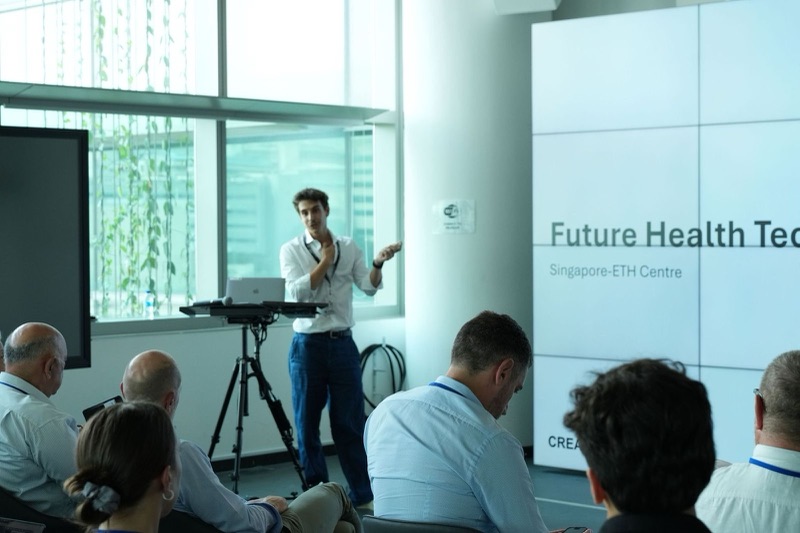
FHT programme · SingaporePresenting at the Future Health Technologies programme, Singapore–ETH Centre.
Doctoral awards · Zurich, 2025ETH Zurich Doctoral Awards Ceremony, 2025.Giornale di BresciaPress feature in the Giornale di Brescia series "I bresciani nel mondo".
Doctoral defence · Zurich, 2025Doctoral defence at ETH Zurich: "A Blueprint for Digital Tools in Early Detection of Cognitive Impairment", 2025.
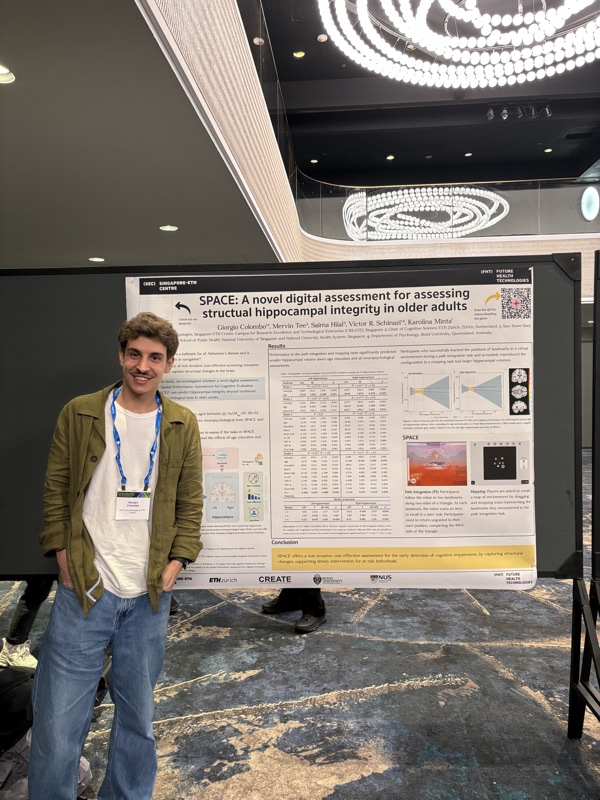
Psychonomics · New York, 2024Poster on SPACE and hippocampal integrity, Psychonomic Society Annual Meeting, New York, 2024.SEC event · SingaporeWalking visitors through SPACE results at a Singapore–ETH Centre event.
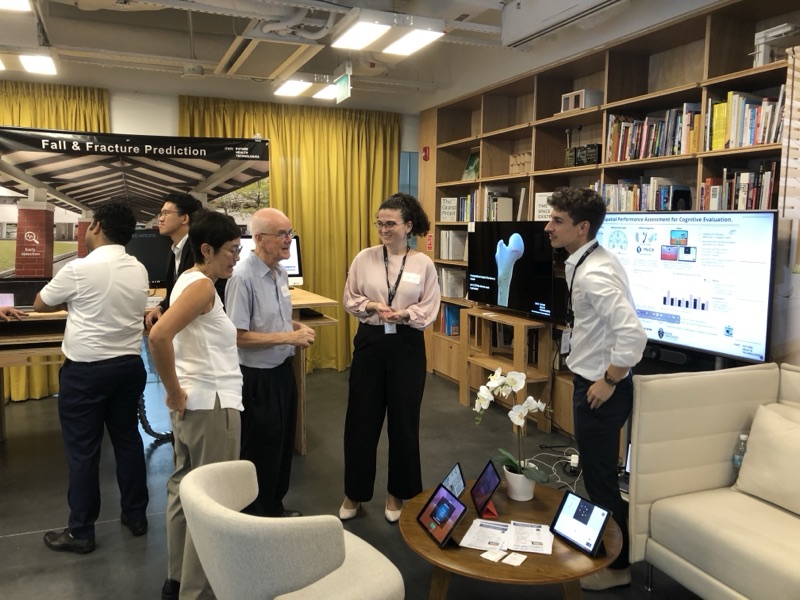
SPACE demo · SingaporeDemonstrating SPACE to visitors at the Singapore–ETH Centre.
FHT showcase · SingaporeSPACE demonstration at a Future Health Technologies showcase on fall and fracture prediction, Singapore.
Let's connect.
Open to collaborations on digital biomarkers, cognitive health, and human-centred AI in healthcare.